

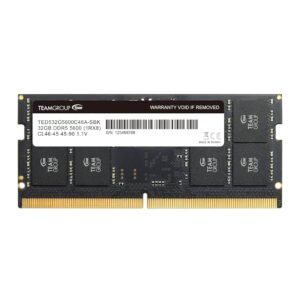

TEAMGROUP Elite SODIMM DDR5 32GB 5600Mhz
Overview
The TEAMGROUP Elite SO-DIMM DDR5 32 GB (5600 MHz) is a high-performance laptop memory module designed to bring next-generation DDR5 capabilities to portable systems. With its impressive speed, energy-efficient design, and robust architecture, it represents a balanced upgrade for users who need both capacity and responsiveness—whether for multitasking, content creation, gaming, or productivity.
Key Features & Technical Specifications
-
High Frequency & Throughput
-
Runs at 5600 MHz, which is part of the PC5-44800 class.
-
This high-frequency operation gives it a significant bandwidth advantage over older-generation DDR4 memory, enabling faster data transfer and smoother performance during memory-intensive tasks.
-
-
Latency
-
CAS latency is CL46 (specifically, often 46-45-45-90 in some modules)
-
While this isn’t the lowest possible DDR5 latency, it’s fairly standard for high-speed, high-capacity SO-DIMMs, and it balances latency with stability and capacity.
-
Disponibilité : Disponible
2 990 MAD3 990 MAD
Bienvenue chez EliteGear, le leader du PC gamer au Maroc ! Nous sommes dédiés à offrir des ordinateurs de haute performance, conçus pour repousser les limites du gaming.
Key Features & Technical Specifications
-
High Frequency & Throughput
-
Runs at 5600 MHz, which is part of the PC5-44800 class.
-
This high-frequency operation gives it a significant bandwidth advantage over older-generation DDR4 memory, enabling faster data transfer and smoother performance during memory-intensive tasks.
-
-
Latency
-
CAS latency is CL46 (specifically, often 46-45-45-90 in some modules)
-
While this isn’t the lowest possible DDR5 latency, it’s fairly standard for high-speed, high-capacity SO-DIMMs, and it balances latency with stability and capacity.
-
-
Voltage Efficiency
-
Operates at 1.1 V, which is lower than typical DDR4 nominal voltage (1.2 V), helping reduce power consumption and heat—especially important in laptops.
-
To further optimize power delivery, the module integrates a Power Management IC (PMIC) directly on the memory stick, shifting power management off the motherboard and minimizing noise and inefficiency.
-
Supports on-die ECC, a built-in error-correcting mechanism that corrects single-bit errors within the DRAM itself.
-
This contributes to greater data integrity and system stability—especially useful in workloads where reliability is important, such as workstation tasks or prolonged productivity sessions.
-
-
Bank Structure & Burst Length
-
Thanks to DDR5’s architectural improvements, the module features 32 banks organized into 8 bank groups (compared to fewer in older DDR standards), increasing memory access flexibility and efficiency.
-
It also benefits from a doubled “burst length” per read/write command vs DDR4, enabling more data to be processed per cycle. teamgroupinc.com
-
-
Capacity
-
The module size is 32 GB, either as a single 32 GB stick or as part of a 2× 16 GB kit depending on model.
-
This capacity is well-suited for power users — multitasking professionals, developers, content creators, or gamers who run large applications or virtual machines.
-
-
Compatibility
-
It is a SO-DIMM format (laptop memory) with 262 pin configuration.
-
Compatible with modern DDR5-supporting laptops, especially those designed to accept high-speed DDR5 SO-DIMMs.
-
Because of its specs, it usually works best in systems that explicitly support DDR5 at high speeds; in some machines, modules like this may run at a lower speed if the system doesn’t fully support 5600 MHz. (This depends on BIOS, motherboard/laptop memory controller, etc.)
-
-
Warranty & Durability
-
TEAMGROUP offers a lifetime warranty for this memory module, which gives users long-term peace of mind. teamgroupinc.com+1
-
The build quality is solid, using high-quality DRAM ICs and design practices to ensure stability and reliability over time.
-
Advantages & Strengths
-
Performance Boost: The 5600 MHz frequency provides a notable increase in bandwidth compared to older DDR4 modules, which translates into quicker loading times, faster data access, and better responsiveness in memory-heavy applications.
-
Energy Efficiency: By running at just 1.1 V, it helps save power and reduce heat in laptops, which can mean better battery life or cooler operation.
-
Stability: On-die ECC and PMIC integration help maintain system stability, minimizing the risk of data corruption, which is particularly beneficial in professional or continuous-use scenarios.
-
Large Capacity: 32 GB is a sweet spot for many power users—it’s large enough to handle serious multitasking, large datasets, or memory-hungry software without going overboard.
-
Future-Proofing: Upgrading to DDR5 5600 MHz gives your system a more modern foundation, potentially extending the useful life of your laptop (assuming the rest of the system supports or benefits from the extra speed).
Potential Trade-offs / Limitations
-
Latency: While CL46 is decent, there are DDR5 modules with tighter timings — but often those come at a premium or in different capacity/speed trade-offs.
-
Compatibility Risks: Not all laptops may support 5600 MHz DDR5, or they may default to a lower speed (depending on BIOS support / memory controller limitations). Users should check their motherboard/laptop QVL or compatibility list.
-
Cost: Higher-speed, high-capacity DDR5 SO-DIMMs like this tend to be more expensive than lower-speed or DDR4 modules. The price may be justified for performance, but it’s a factor.
-
Power Delivery Complexity: While the PMIC improves efficiency, it also adds complexity. In poorly designed systems, this could lead to compatibility quirks (though that is not common).